

Stories from Srimad Bhagavatam
Chapter 4: Brahmana curses Parikshit
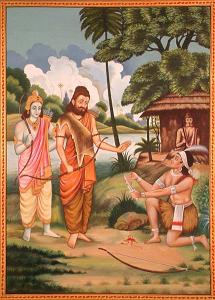
One day, Parikshit was out hunting all alone. He was thirsty after
a hot chase of a herd of deer. Going a long way in search of water, he located
the hermitage of a pious sage named Shamika. The sage was in deep meditation,
resigned from his worldly surrounding and in communion with God. The sage
seated on a deer skin with knotted disheveled hair, was in a sublime state of
mind. The arrival of the king went unnoticed and his request for water also did
not draw the attention of the muni. The king with parched throat and suffering
from near dehydration mistook the sage’s silence as indifference. Hospitality
is the foremost etiquette expected towards the king. Absence of it was
misconstrued by Parikshit as gross insult. Severe thirst had robbed the king’s
good sense. He developed a suspicion as to whether the sage was genuinely in
meditation or was it a pretense to spite him. In a fit of anger, he picked up a
dead snake lying at the doorstep with the tip of the bow and threw it round the
neck of the muni. Then he proceeded homeward in a fury.
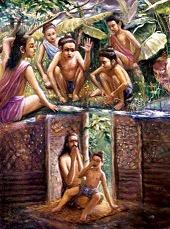
The sage’s son Shringi heard from his friends how his father had
been treated by the king. Feeling very sorry for his father, the young boy, in
an emotional outburst, cursed the king that he would die within seven days,
bitten by the serpent takshaka. Crying aloud, the boy came to the hermitage
when his father had just come out of meditation. On being informed about the
curse on the king, Shamika was extremely depressed over his son’s impulsive
action. He then explained to Shringi the gravity of his mistake. He said, “A
devout follower of Sri Hari has been punished by you. Impropriety is unknown in
his kingdom. Since a brahmana’s curse cannot be reversed, I dread to think of
the calamity that would occur after the king’s death. Degeneration of society
would be a sure consequence with the decline of virtue.”
Chapter 5: The Demon Twins
Shukadeva, during his discourse, described the
rescue of the earth from the deep waters after a deluge. From the Bhagavad Gita
of Krishna we also know that incarnation of
the Lord becomes inevitable when righteousness is in danger due to the actions
of wicked people. The incarnation of Vishnu as a boar was not only to save the
earth sunk under the water but in the process he also killed the demon
Hiranyaksha.
Svayambhu Manu, sprung from Brahma, wanted to
know the ideal way to propitiate the Lord. Brahma said, “Beget worthy sons who
would be future rulers.” Manu could not carry out the orders on the vast sheet
of water with the earth submerged. Brahma was also in a dilemma to find a
solution. Musing over the problem, Brahma noticed a boar in the size of a thumb
emerging from his nostril which instantly grew to a gigantic size. The boar
dived into the water to rescue the earth from the rasatala by carrying it on
his big tusk. Though the boar was none other than the incarnation of Lord Vishnu,
before he could carry out the rescue work, he was confronted by a daitya king,
named Hiranyaksha. It was a bloody battle between the two. Finally, the demon
was killed.
Now, it is intriguing as to why and where from
this demon suddenly made his appearance to challenge the prowess of the divine
boar. So were those listening to the discourse of Shuka. To satisfy their
curiosity, Shuka narrated the story of the birth of the twin demon brothers
Hiranyakashipu and Hiranyaksha.
One day, Daksha’s daughter Diti approached her
husband Kashyapa, a brahmarishi and the son of Marichi. She begged him to bless
her with an offspring and she made her impatience very obvious in her
solicitation. At the end of his daily worship to Lord Vishnu, Kashyapa was
absorbed in meditation at dusk. Sadly, Diti had mistimed her request. Sunset is
an inauspicious time and Kashyapa asked her to hold her patience. He said,
“Dusk is the time when Rudra goes round the worlds, riding his bull. He is in
the company of ghosts and is smeared all over by the ashes from the funeral
pyres. His three eyes are open to survey all directions and nothing escapes his
notice. [Shiva who is believed to have a third eye on his forehead is also
known by the name Rudra, indicative of his destructive character]. I do not
wish to disrespect the deity by indulging in an unworthy act. Shiva happens to
be my brother by marriage to your sister Sati. At a time when even the
divinities of the regions are engaged in reciting hymns in Shiva’s praise, I
would advise you not to succumb to your desires. Rudra though a Pishacha, is
not despised. His commands are carried out with reverence. When such is the
situation, transgression on my part would not be excused by him.” But Diti was
not to be calmed and she insisted her desire be satisfied at once. Accepting it
as the decree of Providence,
Kashyapa yielded with due apologies to Lord Hari.
In retrospect, Diti was ashamed of herself.
Fear of vengeance on her progeny from the short tempered Shiva shook her
mentally. She pleaded her husband to save her offspring from evil. Kashyapa,
though sorry for his wife, did not wish to keep her in the dark about the truth
of her offspring. He told her honestly that by the evil effects of twilight,
the hour of Rudra, she was destined to have demons as twin sons. They would
oppress all the three worlds unchecked. The Lord of the universe alone would be
able to apply a brake to their atrocities. Though she was shocked at first, she
realized that death inevitably follows birth. Therefore, her only wish was that
her sons despite their wicked nature should meet their death in the hands of
Sri Hari. She feared that death caused by a curse or untimely fatal accident
would make them an outcaste in their own race in the next birth. Kashyapa consoled
her that her grandson Prahlada by one of her sons would be a beacon light to
the family. He would compensate by his virtuous life, the evils of Diti’s twin
sons. Assurance from her husband thus, was no consolation to save her from the
dreadful thought of having demons as sons. She held the embryo within herself
for a long time, not allowing it to grow. Yet the unborn did show its
destructive nature by eclipsing the sun and moon rays from the earth. The Gods
were worried about the consequences of the spreading gloom. They expected some
kind of relief on this earth, if the demons were born. Then they would be part
of the happenings, good or bad and possibly that would restrain their evil
activities. Protected in the womb, now, they were inflicting miseries on the
world outside.
Diti had been cursed to beget demons. If that
was to fructify, correspondingly another curse somewhere had to be uttered. So
the Lord, by his own creation, evolved a suitable situation. Jaya and Vijaya
were guards at the gate of Vaikuntha, the abode of Vishnu. Their sincere
devotion had secured them the coveted status
Once, some sages had passed through six doors to Vaikuntha without
difficulty by the power of yoga. Now at the threshold of the seventh and final
door, they wished entry. Sheer self control helped them from being lured
by temptations. Constant dedicated thinking had aroused a longing in their
hearts for a glimpse of Lord Vishnu. Their tenacious effort had brought them
this far. Jaya and Vijaya were suspicious of the identity of the sages and so
refused to permit them inside. Further, as if driven by some kind of insanity,
they behaved very badly towards the saints. Lashing them with canes, they
invited trouble for themselves. The sages were infuriated at the outrageous
conduct. They burst out and said, “Your appointment in this holy region is on
the basis of your meritorious service to the Lord. But to us, you seem to be
unworthy of the honour. You do not even know that the Lord has no enemies in
any quarter from whom he need anticipate harm. People attending on the Lord are
above the mundane distinctions and discriminations. Your behaviour to us only
exposes your spiritual immaturity. We cannot punish you severely as you are the
servants of God but we will not let you go without a certain amount of
reciprocal treatment for your deplorable action. May you be driven out of
Vaikuntha and be born in an unrighteous race dominated by lust, anger and
covetessness!” The two guards of Vaikuntha were shrewd enough to understand the
implications of the words of the munis. Back to their senses, Jaya and Vijaya
fell at their feet and expressed their apologies. They wholeheartedly accepted
the curse as punishment for being sinful, inconsistent with their honoured
status in the abode of God.
Hearing the commotion, Lord Vishnu,
accompanied by Goddess Lakshmi, came out bare-footed to present himself before
the offended ascetics. The sight of his lotus feet for which they had come all
the way, appeased the anger of the sages instantly. Wonder struck at the
lustrous Lord, the sages pleaded guilty for cursing his followers. They
requested the Lord for the withdrawal of the curse or at least to reduce its
severity. On the other hand, if the Lord felt that the munis were wrong, they
were prepared to bear the punishment awarded by him.
The Lord answered, “Since everything has
happened at my behest, these two will have to suffer the fated punishment. They
must be born as asuras. The demons will ever be obsessed with thoughts about
me, arising out of anger. Constant thinking, even though with hatred, would
redeem them of the curse in a short span of time. Having carried out their
curse for a three term period, they will return to my abode.
The story of Jaya and Vijaya provides the
background for the birth of the twin demon sons of Diti. Engulfed in fear of
the disaster expected to occur, she tried to delay their birth. Realizing that
postponing the inevitable was not the solution to the problem, she brought
forth the demons after a hundred years. Evil omens were observed all round,
sending a shiver in the hearts of people. They assumed gigantic physique which
struck universal terror. Their father named them Hiranyakashipu and
Hiranyaksha, the former being considered the elder of the two.
Hiranyakashipu was very fond of Hiranyaksha
who also strived hard to please his affectionate brother. Hiranyaksha, carrying
his mace, once went to the portals of heaven with the desire to fight. The
sight of him sent all the celestial deities rushing to hide themselves. Not
finding any of them even after a thorough search, the asura gave vent to his
anger by a terrible roar. He dived deep into the ocean and lived there for many
years, scaring the aquatic animals. Varuna, the lord of the waters who had been
sighted by Hiranyaksha, was arrogantly invited for a duel. Varuna said, “I have
ceased to fight and I see none who can equal you. If you are really keen about
a battle, Lord Vishnu is the only one who, in my view, seems to be a suitable
opponent for you. He will humble your pride. In the battlefield you will find
yourself on the ground surrounded by dogs.” Hiranyaksha, a fool that he was,
could not catch the sarcasm laden with subtle meaning in Varuna’s words.
Blinded by his sense of superiority in battle, he was exhilarated on finding a
person who could be at par with him. He immediately went down to rasatala where
he found Lord Vishnu as a boar. The boar put up a sham battle. Both of them
were bleeding profusely. The demon thought Vishnu was going to meet his death
at his hands. The asura gleefully looked forward to establishing his supremacy,
with the gods orphaned at the end of the encounter. Vishnu decided he had given
the demon a long rope and it was time to crush him once for all. His sudarshana
chakra completed the job. Diti’s heart throbbed but happily her wish was
fulfilled. With the demon killed and the earth rescued from under the waters,
the Lord went back to his abode, feeling relieved.
Hiranyakashipu was depressed over his
brother’s death. In order to console his family, he explained to them the
philosophy of life. He said, “If a man has not lived through his entire life,
he will be safe even in a fierce forest. If his life span has been completed,
destiny cannot help him escape death even in a well protected house.”
Hiranyakashipu was ambitious to become a
powerful sovereign leader, invincible and ever youthful. He went to the
mountain Mandara to engage in a severe austerity to propitiate the lord of
creation, Brahma. Standing on the tip of the toe, with arms raised and eyes
directed to the sun, he concentrated with the single objective of achieving his
ambition. The religious penance was so vigorously performed that fire emitted
from his head in all directions. The destructive element upset the equilibrium
and the celestial gods were highly agitated. They approached Brahma to help
them get out of the difficulty. They said, “You cannot be a passive spectator
while this demon is making life in heaven impossible for us. Remedial action is
urgently needed before he creates havoc in all regions.” In response to their
plea, Brahma went to Hiranyakashipu with a smiling countenance and offered to
award the boon of his choice for his tough austerity. Hiranyakashipu enumerated
a long list of his aspirations. He said, “Oh Lord! Please grant me
immortality against each one of your creations. Let me not die indoor or
outdoor, during day or night, through men or animals, animate or inanimate
objects or reptiles. Grant me matchless power in battles, undisputed lordship
over the guardians of the worlds. Remaining young, I should enjoy all your
possessions and luxuries which your asceticism has procured for you.” To avert
the disasters as a result of the demon’s penance, Brahma crowned him by
sanctioning all his demands.
With the extensive power thus obtained, there
was no stopping of Hiranyakashipu. Indraloka came under him. Except Brahma,
Vishnu and Shiva, all other lokapalas were subservient to him. He arrogantly
disregarded the shastric ordains and held sway over his ill gotten prosperity
for many years. He also indulged in having intoxicating liquor in large
quantities. Anxious over the unwarranted suffering, the gods saw Vishnu as the
only rescuing power. At the end of their prayers, they heard a voice, the source
of which could not be discerned. The voice enthused the gods with confidence
and said, “Hiranyakashipu’s days are numbered. I shall soon dispel his illusory
notion of being invincible. You should patiently wait. I shall make my
appearance at the appropriate time when I will be instrumental to his death.”
The gods were happy with the promise and began to believe Hiranyakashipu as
already dead.
Chapter 6: Narasimhavatara
Hiranyakashipu’s son Prahlada was a great devotee of Sri Hari. At
the age of five, his intellectual and spiritual maturity was commendable. Quiet
by nature, he was not fascinated by the worldly temptations nor did he show any
interest in playing with the children. He did not nurture enmity towards
anybody, a characteristic contrary to the innate quality of a daitya. Drawn by
his devotion to the Lord, he would sometimes go into a trance. Hiranyakashipu
tried his best to divert Prahlada to his ways of wicked living, by putting him
as under study to the sons of Shukracharya. They failed in their efforts as
Prahlada was guided by the belief that all are the children of God without
discrimination. Hiranyakashipu employed various people to find his source of
spiritual learning. Prahlada’s intelligent reply bowled them out. He said,
“Just as iron filings are attracted towards a magnet, so am I drawn to the
Almighty Chakrapani [weilder of the discus.]. Hence my mind works differently
from yours.” Prahlada patiently bore the severe lashings with canes. Though his
father felt that keeping him in isolation would reform him, it proved to be an
added convenience for the young boy to think of God without disturbance. When
questioned about the best quality learning he has had, Prahlada boldly replied,
“Devotion to Lord Vishnu, meditating, finding immense pleasure in the service
of God, getting engrossed in reciting his glories are the best teachings life
has taught me.”
Hiranyakashipu concluded from Prahlada’s
speech that he was carrying the guilt of his uncle’s death as he found the boy
an accomplice of his father’s enemy, Vishnu. Unable to draw him away from the
Lord, he decided that taking Prahlada’s life was the only way to get rid of
this millstone round his neck. He tried to kill his son through snake bite,
setting an elephant to trample over him, pushed him down a mountain, and
exposing him to severe climatic conditions. He even resorted to poisoning his
food. But Prahlada escaped all of his father’s wicked conspiracies. His
communion with God through meditation continued as usual. Hiranyakashipu began
to foresee self destruction by continuous enmity with his son. The sons of
Shukracharya built up his confidence by saying that a boy of his age could not
pose any danger. However, they suggested the boy be bound with varuna’s noose
till the return of their father, Shukracharya. They also expected him to reform
with age.
Prahlada imparts spiritual instruction to the Daitya boys.
One day, there was some leisure in the absence
of the preceptor. The boys began playing. Prahlada called his friends to initiate
them with regard to the spiritual, more enlightening aspect of life than the
transient happiness of the world. Still in the tender age when their minds
could be easily moulded, the boys showed great interest. Prahlada started
instruction by pointing to them that they were fortunate to be born as humans.
Hence they should not waste it in trivial pleasures which would lead to
ceaseless births and deaths.
The wise should seek the lotus feet of the
Lord for everlasting bliss of emancipation. He went on to explain the various
segments of life in a lucid way to clear their cloudy minds. He said, “A man’s
life span is one hundred years. Of this, half the time he wastes in sleep due
to exhaustion from ignorant indulgence in worldly pleasures. The charms of
childhood and early youth rob twenty years of the remaining half. Nothing can
be achieved in old age when infirmity and senility set in. Another twenty years
are lost there. The balance of only ten years is all that is left for us to
spend constructively in the thought of God. This too we fritter away in trying
to provide comfort and luxury for a happy family life. Then where is the time
for the worship of the Lord? We let slip the real happiness which lies in the
renunciation of the worldly connections and serving the divine feet.” The boys
were awe stricken at the enormous knowledge of Prahlada. They were curious to
know how he had managed to learn so much at such a young age. Prahlada narrated
to them that he had learnt it from Narada while he was in his mother’s womb.
Prahlada began his story to convince the boys about the authenticity of what he
had told them a little while ago. He started, “My father went to the mountain
Mandara to perform arduous penance to please Brahma. Availing his absence, the
celestials planned to wage war against the Danavas [demons]. Indra, who had
lost to my father, wanted to wipe out the demons, expectantly hoping that the
daitya king would die unable to withstand the strenuous austerity. In the war,
the demons deserted their wives and children to save their own lives. Indra
abducted my mother and was carrying her to heaven. Narada advised him to let
her go as she was another man’s wife. Indra said he would keep her in his
custody till she gave birth to his enemy’s child growing in her womb. Until
that child was killed, Indra feared his position would be in danger. Narada
then advised him not to entertain such cruel thoughts against an infant, the
devotee of Vishnu. As a mark of respect to Narada, Indra freed my mother and
she was taken care of by the sage in his hermitage. My mother served him with
reverence. She wished for the easy birth of her child and a safe life
thereafter. The divine sage granted both her wishes. He instructed her about
the value of spiritual pursuit as well as the real nature of religion. I heard
this from my mother’s womb. Due to lapse of time and age, my mother is not able
to recollect the sage’s teachings but it is there in my memory, fresh as if I
heard it just yesterday. This is the truth behind my knowledge. My friends! If
you trust my words, give up your ego. Yogic exercises terminate the actions
that lead to desire and misery. Direct your aspirations towards the Almighty
with honest attachment. This, the learned consider as real happiness. Other
pleasures are mere mockery to which we should not become slaves.”
There was a marked impact on the minds of the boys who began to follow the
teachings of Prahlada. Observing this, the preceptors informed the king about
the overpowering influence of his son on other students. Hiranyakashipu abused
his son as the traitor of the family. Panting heavily he burst out at Prahlada,
“You ill-mannered wretch! You have asserted that your Supreme Being is more
powerful than I am. With that confidence, you arrogantly transgress my
commands. Let him now save you from the jaws of death. If, as you say, he is
all pervading, can you prove he is in this pillar?” So saying he hit the pillar
with his mace. Instantly, there was a loud rumbling sound of deafening
intensity which rattled even the gods. Out of the pillar emerged a fierce
strange form that had a head of a lion and a human body.
Vishnu obviously took this form, called Narasimha [a combination of man and
lion], which was outside the exemptions Hiranyakashipu had secured from Brahma
as protection from death. Narasimha prolonged the encounter for some time till
the demon lost himself to the impression of being the victor. His pride led to
the loss of his sense of reasoning. Piling abuses on the Lord, he hastened his
death and so had the time approached for Vishnu to fulfill his promise to the
gods. It was dusk when Narasimha placed the demon on his lap at the threshold
of the court room. His claw like nails ripped open the abdomen and he pulled
out the entrails, and wore it like a garland round his neck. With blood
splashed all over his face, the lion man looked dreadful. The way the Lord
killed the demon did not include any of those sanctions the demon had obtained.
The time was dusk, neither day nor night; the place was the doorstep, not
indoor or outdoor; the weapon was the nails of the unusual creature and the
lion-man was not any of Brahma’s creations.
Even
after he had slain the demon, Narasimha’s terrible roar indicated that his
anger had not appeased. The gods apprehended disaster when, seated on the
throne, the ferocious lion man was still continuing his awe inspiring roar.
They tried to calm him with songs of praise but it was of no avail. Prahlada
was then asked to sing the glories of the Almighty. Gradually the anger
decreased by degrees. The Lord pleased with Prahlada, offered him a boon.
Prahlada was not to be tempted as he was beyond the worldly desires. He,
however, requested the grant of a small wish. He said, “I am aware of the
impious sinful life my father has lead. Yet, as a special favour, I beg you to
wash his sins away and pardon him.” Admiring the boy’s selflessness, the Lord
told him, “Your father has already been redeemed by your birth. He himself has
been constantly thinking about me though with hatred. Even people disposed
towards me as your father receive my blessings.” Thus Narasimha disappeared.
Prahlada was crowned the king who ruled as a righteous rulers for many years.
Thus
Jaya and Vijaya fulfilled the first phase of the brahmanas’ curse. In the next
birth they were Ravana with ten heads and his brother Kumbhakarna who were
klled by the Lord in his incarnation as Rama. Finally, they were born as
Shishupala and Dantavaktra, who were the victims of Krishna.
Interesting Anecdotes
Goddess Lakshmi : Goddess Lakshmi, an embodiment of sympathy
and compassion has a special place next to the heart of Sri Hari. After the
death of Hiranyakashipu, she stepped down from the honoured place in protest.
Not knowing the cause for Lakshmi’s decision to forsake him, Vishnu was
perplexed. He requested her to reveal the reason for abandoning him. She said,
“My faith in your mercy has fallen by your treatment of Hiranyakashipu. You
never gave him a chance to reform. Prompted by your anger, you mercilessly
killed him. Should you not have helped him to conquer his mental aberration?
You should endeavour to kill the evil and not victimize the person who is
wicked due to ignorance.” Narasimha realized his folly and promised to be
careful in future, not to impose outright punishment without trial. Pleased
with the Lord’s promise, she compromised to sit on his lap. That is why we find
her on Lord’s lap in the Narasimhavatara. This was a trial for the Lord himself
to convince Lakshmi that reformation would be the first step before convicting
an erred man to capital punishment. Thus in his birth as Rama, he could have
killed Ravana when he had lost his army, weapons and even his chariot. But
Ravana was sent back at the end of the day, to reconsider his attitude towards
Sita. Krishna also upheld his promise to his aunt to pardon Shishupala till he
committed one hundred sins
Chapter 7: Child Prodigy Kapila
The revered rishi Kardama, in the satya yuga,
was engaged in difficult austerities on the banks of river Sarasvati for ten
thousand years. His intense meditation pleased Lord Hari, and he made his
appearance, seated on his vehicle Garuda, in great splendour. Goddess Sri was
seated on his bosom and he was wearing the gem Kaustubha. Kardama thought
himself to be among the chosen few to be favoured thus by the Lord. When asked
to make a request, he told the Lord, “I wish nothing from you except a wife who
would be a devoted partner in the discharge of my religious duties. I find this
necessary because I cannot perform religious rites to the deities, rishis and
my manes without a wife.” The Lord said, “I am aware that you are free from
lust. Your meditation is directed only to me and the efforts of devoted people
never go futile. The wealthy prosperous Manu, the lord of the prajapatis, will
visit you soon with his wife Shatarupa. Of his daughters, one named Devahuti,
endowed with beauty and character is worthy to be your wife. She too wishes to
have a husband of your stature. She will help you fulfill the commands of
Brahma to procreate for which you are going through the grinding penances all
these years. This fair daughter of Manu will bring forth nine daughters who in
turn will beget many children by their marriage to sages. I expect you to
dedicate the fruits of your actions to me. As a householder, kindness and
concern for universal welfare should be your guiding principles in life. When
you have discharged your duties, renounce the world and take to sanyasa. You
will then realize that I am the primeval base on which you and everything in
this universe subsist. Your wife will beget a son by my divine energy who will
be the founder of the Tattva Samhita.” The Lord disappeared after revealing the
future. He strictly instructed the sage to adhere to his directions regarding
the proper discharge of duties.
Soon
Manu and his wife arrived at the rishi’s hermitage as expected. Manu was
enchanted by the beautiful surroundings, which had trees with bushy foliage
housing various species of birds and animals strolled around freely. Lord’s
appearance at the hermitage to bless the sage had enhanced its sanctity. The
royal couple entered the thatched cottage of the sage who welcomed them with
due respect. The king broached the subject of marriage to the muni and said he
would be greatly honoured if he accepted his daughter’s hand in marriage. He
introduced his daughter Devahuti as the sister of his two sons Priyavrata and
Uttanapada. Ever since she heard about Kardama’s spiritual accomplishments, she
had decided on him as her husband. Kardama accepted her with pleasure. After
celebrating the marriage of their daughter, the king and the queen took leave
with a heavy heart as they had to return to their kingdom.
Devahuti served her husband with devotion in all the religious duties he
performed. Thus many years went by happily without any complaint from Devahuti
for the austere life she had been following. Kardama was pleased with his
wife’s attitude and he felt duty bound to reward her with a boon. He offered to
grant her divyadrishti, spiritual insight by his yogic powers which would
enable her to enjoy the divine pleasures. Instantly she was relieved of her
responsibilities. She however bashfully expressed her desire to have children.
Kardama immediately employed his yogic powers to bring a celestial car
descending to the earth endowed with all imaginable comforts and pleasures. He
asked her to have an ablution in the water of the river Sarasvati flowing
nearby. As soon as she got into the water, she saw many damsels ready with
beautiful clothes, ornaments, flowers and perfumes. All decked, she emerged
from the water to present herself before her waiting husband. They led a happy
married life in that divine luxury for many years.
The yogic powers helped Kardama to divide
himself in nine different ways which resulted in the birth of nine daughters to
Devahuti. Now he directed his mind to understand the identity of the Lord that
revealed the futility of worldly objects. Detachment prepared him for
renunciation, to live the life of a mendicant. Observing the changed attitude
of her husband, Devahuti was crest fallen. She told her husband woefully,
“Married to an intellectual like you, I failed to recognize the value of life. I
wasted it in material happiness and did not ever think of meditating on the
Supreme Lord. When you are on the verge of leaving, light has dawned on me.
Without you how am I going to find worthy husbands for our daughters? Who will
teach me the philosophy of life?” The maharshi replied, “Do not panic
unnecessarily. Nothing is lost. Withdraw yourself to the meditation of God.
Unperturbed, you concentrate on the Lord responsible for creation, preservation
and destruction. You will realize he is Lord Vishnu rolled into one. Pleased
with you, a part of his energy will enter your womb and be born as your son.”
Devahuti obediently observed her husband’s advice and was with a child with the
Lord’s grace, who was to be her son.
Meanwhile, Brahma was pleased with Kardama’s obedience to his
advice. He asked him to perform the marriage of his daughters to eminent sages
like Marichi and the like. That would help him [Brahma] multifariously in his
effort to propagate. Brahma told Devahuti that her son would command great respect
among siddhas and saints for his Sankhya School of Philosophy. He will be known
as ‘Kapila’. His wide spread fame would be a matter of honour for his parents.
Kardama performed the marriage of his daughters. The prospect of having the
Lord as his son aroused an exhilarating feeling. He thanked God for his special
mercy. Renunciation followed by meditation secured him the feet of Lord Vishnu.
Soon Kapila was born and he lived with his mother to keep her happy. He
preferred to keep himself in isolation as he believed in the tattva marga. One
day, his mother recollected the words of Brahma about her son. She approached
Kapila and said, “Oh revered one! You are the Lord incarnate. Show me the path
of light that will remove the darkness of ignorance pervading in me. By your
grace, I want relief from the bondage of birth and death. You have been born to
deliver people from getting drowned in a life of material infatuation. You are
the foremost to know the moral values of life. Kindly lead me to emancipation
through enlightenment.” Impressed by his mother’s genuine curiosity towards
knowing the Ultimate Truth, he became her preceptor. First he explained to her
that except Vishnu everything is maya, illusory appearances, pitfalls from
which one has to be guarded. Universal love would extricate a man, who wishes
supreme bliss, from evil thoughts and actions. Sincere devotion would earn him
the love of God, affording communion with the Almighty. Kapila helped his
mother to comprehend the Divine, the goal to be aspired in life by one and all.
After completing the spiritual instruction, he took his mother’s permission to
leave for an austere life in the north. He dedicated his entire life time for
the upliftment of all. To this day his Sankhya Philosophy is firmly established
on earth drawing many followers.
Devahuti too left the hermitage without any regret except that she
felt sorry for the separation from her son. She contemplated on her son, the
incarnation of Vishnu. Meditation became her way of life.
Interesting Anecdotes
Putrika vow: This vow is taken by a
man without a son during the wedding of his daughter. A son born to her would
become his adopted son according to the agreement. Manu had three daughters
Akuti, Devahuti and Prasuti. He also had two sons Priyavrata and Uttanapada.
Yet he entered into the above agreement during the marriage of his daughter
Akuti with prajapati Ruchi. Ruchi, having the splendour of Brahma, had a son
and a daughter. The son named Yajyna, was the incarnation of the sacrificial
form of Vishnu. The daughter was Dakshina, an incarnation of Vishnu’s consort
Lakshmi, for the goddess manifests herself as the fees given to the priests
during sacrifices. Manu delighted by the boy’s glory, adopted him as his son.
Dakshina continued to live with her parents. A very peculiar incident happened
when these two children grew up to marriageable age. Dakshina expressed her
desire to marry Yajyna. The alliance was permitted by the Putrika vow. Further,
the boy was the form of Vishnu, and the girl, the form of Lakshmi, both
inseparable divine couple. To their delight, the marriage was performed and
they had twelve sons.
Heavenly Ganges: Devakulya, the grand-daughter of Kardama, became the
heavenly river Ganges in her next birth. She assumed the form of the water she
had used for washing Sri Hari’s feet.
The sons of Atri: Anasuya, daughter of Kardama, married rishi Atri.
Their three sons, Soma, Lord Dattatreya and Sage Durvasa were the incarnation
of Brahma, Vishnu and Shiva respectively. The unusual occurrence of the trinity
being born to the same parents has an interesting story. Atri was ordered by
Brahma to engage himself in the propagation of creation. The rishi with his
wife went to mountain Riksha to perform severe penance. For one hundred years
he stood on one foot, subsisted on air, defied cold as well as heat and
controlled his mind through pranayama. His only thought was to be blessed with
offspring by the propitiation of the Supreme Being. Besides being pleased with
his efforts, the three Gods were concerned about the danger of the fire
shooting out of his head as a result of his rigorous practice of pranayama.
They appeared before him to convey their satisfaction. They gave their word to
him to be born as his three sons. The sage prostrated before the Gods for their
blessings. He looked a little puzzled at having won over the three Gods when he
had meditated only on the Supreme Lord. They explained, “The three of us
together constitute the Ultimate Truth. In appreciation of your steadfast
resolve, we wish to reward you by being born as your sons. Endowed with our
energy, may their erudition be celebrated in the world and bring fame to you!”
Shukracharya and Markandeya: Khyati was Kardama’s
daughter married to sage Bhrigu. They had a daughter named Kavi. The revered
Ushana, popularly known as Shukracharya, the preceptor of the demons, was her
son. Kavi had a brother Datta. His grandson was Markandeya by his son Mrukanda
and great grandson of Bhrigu. Markandeya had the good fortune of never aging.
He was born by the blessings of Shiva.
Mrukanda and Marudvati were without a child
for a long time. Severe austerities performed to propitiate Shiva, presented
the lord before them. He wanted to know if they would like to have a son with
intelligence and short life or an unintelligent boy with longevity. They opted
for the first offer. Markandeya was hence born with a life span of only sixteen
years. He was an ardent devotee of Shiva and became well versed in all
subjects. He had mastered the mahamrutyunjaya mantra. On the day of his death,
when Yama came to claim his life, he found him praying in the temple before the
Shiva Linga.The boy was frightened at the sight of Yama and clung to the linga
for protection. Yama threw his noose at the boy which encircled the linga along
with him. Enraged at the audacity of Yama, Shiva emerged and struck down with
his trident the Kala, as he is called, for Yama decides on the time of death of
everyone. Thus Shiva gets the name 'Kalaharana.' Shiva blessed Marakandeya with
eternal life and also proclaimed that he would ever be sixteen years of age.
Devas pleaded Shiva to revive Yama to save the earth from being overburdened
with no one to keep control over the birth and death in the right proportion as
a check on the growth of population.
There is a story connecting Markandeya with
Vishnu. Once the earth was about to be engulfed by water when Parvati closed
Shiva's eyes in a playful mood and there was darkness all round signifying the
oncoming of the doom's day. There was only a single trunk of a barren mango
tree standing amidst the surging water. Markandeya climbed the tree and prayed
to Shiva to rescue the earth from the impending calamity. That is why Shiva is
also called 'Ekamreshvara'. Hearing the distress call, Vishnu appeared as a
child on a banyan leaf and asked the boy to enter his mouth to save himself
from the rising water. Inside, Markandeya saw the entire universe, with the
seven regions, the seven oceans, mountains and kingdoms inclusive of living
beings. Confused at the extraordinary vision, he started praying to Vishnu to
draw him out of the baffled state of mind. Vishnu appeared and declared himself
as time and death. Markandeya then lived with Vishnu as his devotee for
thousands of years.
Nara and Narayana: Daksha, the self born son of Brahma, married
Prasuti, the third daughter of Manu. They had sixteen daughters. Thirteen of
them were married to Dharma, one to Agni, another to the Pithrus and the last,
Sati, to Bhava [Shiva]. Virtuous Murti, married to Dharma, gave birth to two
ascetic sons Nara and Narayana. Celestial music, playing of instruments,
beating of the drums, dancing and rejoicing marked their birth. The two
ascetics, the incarnation of Hari, were extolled and honoured even by gods.
Having blessed all the people, these two went away to mountain Gandhamada. They
descended again on earth during the Mahabharatha age as the two Krishnas,
meaning having dark complexion, one was Lord Krishna and the other Arjuna. Sri
Krishna the Narayana, the head of the Yadu race, was born to releive the earth
from the burden of wicked people. Arjuna, the Nara was the valiant warrior of
the Kuru dynasty and the companion of Krishna. Arjuna, one of the sons of Pandu,
was later referred as Pandava along with his other brothers. His cousins, the
sons of Dhritharashtra, acquired the name Kaurava. In fact both of them were
the descendents of king Kuru.
Rantideva: King Rantideva was the
son of Nara of the Bharadvaja family. His glories were sung world over. In
order to satisfy the needs of others, he quite often went on starvation and
thirst. Once, he and his relatives went without food and water for forty eight
days and they were near collapse. On the forty ninth day, lot of food poured
into the hands of Rantideva. He distributed the food to all his relatives and
had just enough for himself. To test his patience, generosity and will power,
God came in various forms as a brahmana, a menial, a pack of mongrels and finally
as a chandala begging for food and water. The kind king parted with all the
food and also water to the last drop unmindful of his critical need. Lord
Vishnu presented himself in his real form before Rantideva. Beholding the Lord,
his mortal needs vanished and all that he was conscious of was worship of Lord
Narayana. He and those closely associated with him became saints devoted to
Lord Narayana.
Chapter 8: Shiva versus Daksha
Once during a gathering of gods, sages, prajapatis and other
divinities in a sacrifice, there was a minor incident that snowballed into a
major scuffle between Shiva and Daksha. When everyone had taken their seats,
the illustrious prajapati Daksha walked in. He offered his respects to his
father Brahma and proceeded to the honoured seat offered to him. Everyone stood
up as a mark of respect and waited for Daksha to be seated. Then Daksha noticed
that Shiva was already sitting, even before he was in his place. As the father
of Sati, thereby Shiva’s father-in-law, he took it as a blatant insult.
Daksha’s anger erupted like a volcano and he spat out derogatory abuses
followed by a curse. He started off at a tangent calling him inauspicious
though with the name Shiva signifying auspiciousness. He said, “It was destiny
that tied me down to him by the advice of Brahma. I have thus sacrificed my
chaste daughter Sati by agreeing to give her in marriage to this wicked man who
has transgressed the basic code of conduct. With ashes from the funeral pyre
smeared all over his body, human skulls round his neck as garland, residing in
the cremation ground among spirits and ghosts, unkempt matted hair, oh! What a
repulsive personality he bears. He will not be treated at par with gods nor
will he partake any sacrificial offerings in their company.”
Shiva remained in his seat without any
reaction. His ardent follower Nandi could not contain himself. He retaliated
with a counter curse on Daksha and his followers. He shouted at Daksha, “You
are engulfed in the darkness of ignorance. Your ego is inflated to such an
extent that you have no spiritual elevation. You are merely rolling in the mire
of worldly pleasures. The cause of this is due to the incorrect or rather no
understanding of the Vedas. May you continue to suffer going through the cycle
of birth and death in this material world! May you with your followers, never
acquire the mental illumination for spiritual bliss!” Daksha in response
uttered another curse on the devotees of Shiva. Like Shiva, he wished them also
to be amidst inauspicious things, smeared with ashes. After the emotional
outburst, he left the assembly in a huff, despite requests to stay on, from the
eminent guests present there. Shiva, though maintaining his composure, was
terribly upset at the enmity building up towards the destruction of the two
rivals. However, the sacrifice was completed without any hindrance by the
prajapatis assembled there.
Chapter 9: Sati renounces life
Daksha became very proud on being appointed as
the head of the patriarchs. Hence he continued to insult Shiva. He
intentionally ignored to invite Shiva to the sacrifice called brihaspatisava he
was performing. Sati saw the celestial couples proceeding to attend the
function, decked in fine clothes and jewelry. Sati was tempted to participate
in the festivities along with her sisters and receive the gifts from her
parents. She wanted Shiva to accompany her to be honoured as the son-in-law. He
explained to her that it would end up in humiliation if he presented himself
uninvited. He also advised her not to go as she was sure to come to grief.
Though Daksha’s favourite daughter, Sati was now his enemy due to her
association with Shiva. Pointing out Daksha’s insults to him for no fault of
his, he requested her not to ignore his advice. Sati cast a scorching look at
Shiva as an expression of her disconsolate mind and frustrated desire. Shiva,
however, could foresee the destruction of Sati either way. So he saw no point
restraining her any further.
She decided to disregard her husband and set
forth for her fatherland. She was disappointed at the cold reception from her
father who purposely avoided her. He made no enquiries about her or her
husband’s welfare. Her mother and her sisters were very cordial though others
kept themselves aloof for fear of Daksha’s reactions. There was no portion of
the sacrificial offering allotted to Shiva. She could infer that it was a
calculated action on her father’s part to rub in his animosity towards her
husband. Her sorrow at her father’s persistence in insulting Shiva found an outlet
in her angry words and she said, “I feel ashamed to call myself your progeny.
You are blinded to the pious qualities of good people. You have failed to
respect Shiva, the law maker of the universe, whom no one defies. I consider it
below my dignity to have a body that has taken birth from a wily person.
Hereafter, Shiva calling me Dakshayini will sound as an insult to my ears and I
cannot allow him to use that epithet. In sheer disgust and hatred towards you,
I have decided to end my life by intense yogic practice.” The yogic powers sent
her up in flames in the final stage of samadhi. Sati’s supporters rushed
towards Daksha to kill him. Bhrigu muni’s oblations into the fire brought forth
gods to control the supporters of Sati, and sent them away from the sacrificial
site.
Hearing Sati’s renunciation of life, Shiva
sent a gigantic person created from one of the locks of his matted hair. He was
endowed with Shiva’s destructive powers to tackle the situation as deserved.
Virabhadra, thus commissioned, could not sever Daksha’s head even with repeated
attempts. In astonishment, he began to think of an effective device when a
slaughtering machine nearby drew his attention. He instantly inserted Daksha’s
head into the machine which severed it. Everyone censured the act but
Virabhadra was hardly affected. By his power, the entire sacrificial structure
was in flames and with his work completed, he went back to Mount Kailasha.
Narayana and Brahma had anticipated the
disastrous consequence of the friction between Daksha and Shiva. Conveniently
they absented themselves from the sacrifice. Shiva caused the death of
Daksha that left his sacrifice half way through. Gods sought Brahma for help.
Brahma offered a suggestion that could solve the problem. He asked the gods to
surrender at Shiva’s feet for forgiveness. Brahma also went to Shiva to advice
him not to blow trivialities out of proportion and let bygones be bygones.
Shiva told him that Daksha’s childish behaviour had not affected him in the
least. His purpose was to chastise Daksha in the grip of illusory power of
maya. Shiva graciously pardoned Daksha. Since Daksha’s head had turned to
ashes, being thrown into the sacrificial fire, Shiva suggested a goat’s head
could be put in its place .Other gods were variously provided with limbs lost
in the combat.
With Daksha revived with a goat’s head,
everyone moved to the sacrificial ground with Shiva and Brahma. Daksha shrunk
in shame at the sight of Shiva. As if woken from deep sleep, Daksha felt
cleansed of his sins. He profusely apologised for his behaviour towards Shiva,
ignorant of his power and greatness. He thanked Shiva for his kindness and
admitted he would never be able to reciprocate it in equal measure. Before the
sacrifice was resumed, Brahma, Shiva and Daksha propitiated Lord Vishnu
inviting him to honour the occasion with his consort. Vishnu then made known to
all that it was he who appeared in the three forms of Brahma, Vishnu and Shiva,
in accordance with his activity of creation, preservation and destruction
respectively. After all the disastrous happenings, calm prevailed with the
reconciliation. There was a lurking grief in Daksha’s heart for having lost his
dear daughter Sati. She was good enough to come to the sacrifice without any
grouse against her father but he threw her out with his deliberate
indifference. It pricked him deep with guilt because his foolish adamant
behaviour had driven her to death. She was again born to Menaka and Himavan as
Uma and united with Shiva as his wife.
Chapter 10: Dhruva the North Star
Manu had two sons named Priyavrata and
Uttanapada, both incarnations of Vishnu. Uttanapada had two wives, Suruchi and
Suniti. Suruchi was dearer to him than his other wife. One day, Uttama was on
his father’s lap when Uttanapada and Suruchi were seated on the throne.
Suniti’s son Dhruva, a child of five years, with a desire to sit on the lap
along with his brother, tried to climb on to his father. Uttanapada made no
attempts to help the small child to come on to his lap or show any affection by
fondling him. Suruchi, the domineering wife, hurt the tender feelings of the
child with harsh words. She said, “It’s a pity you are Suniti’s son unlike
Uttama who happens to be mine. You do not have the good fortune to sit on your
father’s lap nor the right to the throne. If you wish to enjoy the privilege at
least in your next birth, engage yourself in the meditation of the Supreme
Lord. Go through severe austerities by which you may hope to be born as my son
then.” Uttanapada was a silent spectator without any reaction. Dhruva
was terribly upset by his step-mother’s heartless words. He ran to
his mother crying inconsolably. She was also depressed on hearing about the
incident from the attendants. With eyes filled with tears, she said, “Just as
your step-mother told you, my dear child, being my son you cannot aspire for
the throne. Your father does not love me. I would advise you to emulate your
illustrious grand-father. Strenuous penance and sincere service at God’s feet
helped him finally attain emancipation after a prosperous life as a king.”
Inspired by his mother’s wise advice, he
started towards the forest for practicing arduous penance. At that time, Narada
came to dissuade the boy from venturing into such a rigorous task. He said,
“Dhruva, your age calls for a life of enjoyment and play, not for penance. Do
not allow the words of wicked people to make any dent on your mind. At the same
time let not the words of praise inflate your pride. The path you have chosen
is not a bed of roses but a thorny one beyond your capacity to withstand. Go
home, enjoy your childhood and come back when you are old enough for this kind
of life.” Dhruva thanked him for his concern but with humility conveyed to him
that his mind was set on the goal. Impressed by his steadfast determination,
Narada advised him to go to Madhuvana on the banks of Yamuna. He also taught
Dhruva the nuances of penance to reach the Almighty. With due respect to the
sage, Dhruva took leave to repair to the holy place.
On reaching his destination, he meticulously
followed the instructions of Narada, with complete control over his mind and
senses. He gradually increased the interval between the intake of food and
finally he even gave up inhaling air so vital for existence. Standing motionless
on one leg, withdrawn from the material world, Dhruva meditated on the Supreme
Being. The gods were agitated with the high energy released by his penance and
the earth too developed a depression by the pressure of his toe. With an
intention to relieve the gods of their tension and in particular to express his
delight over the small boy’s devotion, Lord Hari appeared before Dhruva. He
told Dhruva that he would rule over his father’s kingdom for many kalpas and
his life will finally culminate in the spiritual bliss. He also promised Dhruva
a place of honour in the firmament as the brightest ever shining star. Dhruva
became the Pole Star in the sky also known as the North Star.
Receiving the blessings, Dhruva started homewards to his father’s
kingdom. Contemplating on his way back, he realized that he did not entertain
any hatred towards his step-brother or step-mother. He was not angry over his
father’s partiality. On the other hand he repented for his mental attitude when
he walked out of the house. His only aim at that moment was to win the same
degree of affection and attention from his father as his brother. He regretted
aspiring for such a petty thing instead of Sri Hari’s blissful realm. He felt
that in all probability, he was urged by jealousy, while immature age and mind
eclipsed the wonders of attaining God. Endowed with a wider perspective of the
value of life now, he grieved for his previous misplaced choice.
In the kingdom, Uttanapada did not have peace of mind. May be, he was silent to
Surichi’s rebuke out of fear for his cantankerous wife. In reality, he might
have had no hatred for Dhruva, being Suniti’s son, as Suruchi had made it
appear. So he was suffering from a sense of guilt for being instrumental in the
exile of his son. Though he was assured by Narada about Dhruva’s outstanding
future, he could not pardon his cruelty to his young child. To make amends for
his past ill treatment, he proceeded to receive his son with honours. He placed
him on an elephant for everyone to see the young boy who had won glories
inconceivable at his age.
Uttama was disinterested in ascending the throne. He was however killed by a
yaksha in the forest. Dhruva was made the king. He was infuriated about his
brother’s death. Manu appeared before Dhruva to stop his inimical aggression
towards the yakshas. He showed him the righteous way to deal with such
situations. War was not the solution. Stooping low to retaliation influenced by
emotion or sentiment was not worthy of a wise man. Equanimity should have
command over ones frame of mind. Dhruva decided to turn a new leaf in his
attitude in handling trying situations. He ruled successfully for many kalpas
as advised by Manu. Then he retired to the forest in quest of spiritual
emancipation.
Chapter 11 Prithu the sovereign king
Sage king Anga of the Dhruva lineage was a pious man strictly
observing the scriptural injunctions. He married Sunitha, daughter of Mrithyu.
When Anga’s offerings were rejected by gods during the horse sacrifice, he
acted on the advice of brahmanas to perform a sacrifice for the birth of a son.
Subsequently, a son was born to him whom he named Vena. Unfortunately, he
imbibed all the unrighteous qualities of his grand-father Mrithyu. Anga’s
efforts to reform his son failed for he seemed to be incorrigible. In disgust,
Anga left his palace in the dead of night and his whereabouts could not be
traced. The kingdom without a ruler was plundered by robbers and dacoits.
Insecurity had spread like wild fire. The brahmanas decided to make Vena the
king. True to his nature, he turned out to be an undependable king. His wicked
ways caused the earth to become barren of its fertility and prosperity. The
arrogant king considered himself superior even to Lord Narayana by whose grace
he was born. The brahmanas could not tolerate him and he died by their curse.
Now the country continued to languish in unhappiness. Vena had died without a
successor. The brahmanas used their yogic powers and brought a boy and a girl
from the arms of the dead body of Vena. They were christened as Prithu and
Archi. They were the forms of Lord Narayana and Goddess Lakshmi. As they
represented the eternal divine couple, a marriage was possible between the
siblings.
Prithu was a righteous pious king. Despite his efforts to bring
normalcy on earth, he witnessed only wide spread adversity and famine causing
many hunger deaths He was angry with mother earth for swallowing the seeds and
plants which caused crop failure in his kingdom. Therefore, he thought of
destroying her to seek his revenge. Earth begged his mercy and said she had
swallowed the herbs and plants to protect them from the wicked people. She
asked Prithu to get a calf while she took the form of a cow. By milking her,
the seeds and plants would flow out like milk. Since she would be the wish
granting cow Kamadhenu, all gods could milk her to obtain things according to
their desire. Prithu cheerfully acted as directed. With abundance of fertility
and prosperity, suffering was completely forgotten as a bad dream.
Prithu was, with all seriousness, engaged in the marathon
performance of a hundred horse sacrifices. At the start of his hundredth
sacrifice, Indra thought his supremacy would be lost if Prithu managed to
complete the final one. He stole the sacrificial horse as an obstruction to the
successful completion of the sacrifice. Prithu’s son, on the advice of sage
Atri, retrieved the horse from Indra who could not deceive the boy by his
disguise. Prithu aimed his arrow against Indra. Brahma wanted to avert the
disaster that would follow. He advised the king to withdraw the arrow forthwith
and also give up the last of his horse sacrifices. Brahma explained to Prithu,
since he and Indra were the forms of the Supreme Lord, it was absurd to kill
one another. It would amount to killing oneself. He told him that he had
already equalized Indra by his ninety nine horse sacrifices. He further said
that Prithu should, hereafter, endeavour to impress upon people about the value
of virtue as against evil which is detrimental to spiritual development.
Brahma’s advice refined his mental outlook. His excellent governance based on
Dharma is even today compared to that of Yudhishthira and his glories are sung
as those of Lord Rama
Interesting Anecdotes
Nishadas: The Nishadas belong to an aboriginal tribe, short and
stunted, residing in the mountainous forests. In the Ramayana, Guha, a nishada
chief ferried Rama across the Ganges in his boat. The story of the origin of
this tribe is quite fascinating. Vena’s deplorable behaviour and his tormenting
attitude towards the subjects, forced him into a premature death by the curse
of the brahmanas. Without an heir to carry on the lineage of the noble king
Anga, the brahmanas attempted to produce a successor by their yogic powers from
the thighs of Vena. Much to their disappointment, a nishada emerged who was not
eligible to be crowned as the king. In their next attempt, Prithu and Archi
were born from his arms. But the brahmanas allowed the nishada to live and thus
the tribe came into existence
Chapter 12: Gajendra and the crocodile
There was a mountain named trikuta beautiful
with scenic grandeur. Surrounded on all sides by the milky ocean, trikuta was
extensive at its base and in height as well. It had three peaks of iron, silver
and gold. Its caves resounded with sweet musical sounds accompanied by the
roaring of frightened lions, anticipating danger from their enemies. In one of
its valleys, Varuna possessed a fascinating garden with a lake. In the
refreshing water of the lake, the celestial damsels had a bath after playing in
the garden. In the nearby mountain forests, there lived a herd of female
elephants, led by a very powerful male elephant named Gajendra. The male
elephant struck terrible fear in other animals by trampling on the bamboo
bushes and devastating huge trees. Intoxicated by his pride of strength, he did
not realize the magnitude of the oppression he was inflicting on the animals.
Once, the male elephant with his female
friends went to the lake to quench his thirst. While he was sporting in the
water, a strong crocodile caught hold of his leg and would not let it go. The
combined effort of all the elephants was no match to that of the crocodile. The
male elephant could not be extricated and the struggle appeared like a tug of
war. The elephants feeling exhausted, gave up the fight as lost. Just then it
flashed to Gajendra to eulogise Sri Hari who alleviates the miseries of all. He
called out to the gracious God, “Oh Lord! You are the omnipotent God guiding
all deities. You create, sustain and annihilate, the only Lord possessing the
threefold power. Saviour of all creatures! Please save me from the firm grip of
the crocodile.” On hearing the pitiable cry of the elephant, the merciful Lord
descended to the spot on his Garuda. Emotionally overwhelmed by the Lord’s
instant response, the elephant bowed low in obeisance, with his trunk raised
with an offering of a lotus in it. The Lord rescued the devotee by striking his
discus on the head of the attacking crocodile. There was all round joy among
the celestial deities in admiration of the Lord’s mercy.
The indisputable truth that is apparent from
the story is, ‘God delivers his devotees from the clutches of the wicked.’
Herein, the twofold mercy of the Lord can be observed. The crocodile in its
previous birth was a gandharva by the name Huhu. He was cursed by Devala,
another gandharva, for some unknown reason by which he had now taken the form
of a crocodile. Lord’s discus redeemed it from the curse. It assumed the resplendent
form of a gandharva, paid his obeisance to the Lord and returned to his region.
It is heart rending to know the plight
of Gajendra in the previous birth. There was a Pandya king named Indradyumna, a
dedicated devotee of Sri Hari. Once in a hermitage on mountain Kulachala, the
monarch was observing rigorous self control in a vow of silence. Wearing matted
hair, he was engrossed in the worship of Sri Hari. At that time, the eminent
rishi Agastya came to the monarch’s hermitage. Seeing the king not coming
forward to offer respects to him, the rishi was infuriated. He took it to be a
conscious indifference and punished him with a severe curse. He said he should
become an arrogant elephant with a perverted mind. Accepting the curse as the
will of God, the king had been living as an elephant since then. The tragic
part of the elephant’s life was that the thought of Lord Hari had been erased
from his memory. But at the time of complete helplessness, his devotion as
Indradyumna stood him in good stead. When all physical efforts had failed to
save him, the forgotten truth of the greatness of God came back to his mind. He
realized that Narayana was the only power to pull him out of his difficulties.
God saved him from the curse and the king’s earlier devotion helped him to
salvation.
Om Tat Sat
(Continued...)
(My humble salutations to Kasturis dot com and Hinduism dot org for the collection)
(A Tribute to the great Bharatiya Samskruti)